

Your parking lot is one of the largest and most visible investments on your commercial property. It is the first thing tenants, customers, and visitors encounter, and the last impression they take with them when they leave. Yet for many property managers and facility directors, parking lot maintenance is one of the first things pushed to the bottom of the priority list when budgets are stretched and schedules are full.
At DRYCO, we have worked with commercial property owners across the Bay Area and Central Valley since 1985, and we have seen firsthand what happens when parking lot maintenance is deferred – and what is possible when it is done right. In this guide, we break down the strategies that deliver the best return on your pavement investment, the warning signs that demand immediate attention, and how a structured maintenance program can add decades to the life of your parking lot.
The Real Cost of Neglecting Parking Lot Maintenance
A well-maintained asphalt parking lot can last 25 to 30 years. Without consistent maintenance, that lifespan can be cut in half, and the costs compound quickly. Minor surface cracks that could be sealed for a few hundred dollars become potholes that require patching for thousands. Potholes left untreated lead to base layer damage that demands full-depth repair or complete replacement, an investment that can reach tens or hundreds of thousands of dollars depending on lot size.
Beyond the direct repair costs, a deteriorating parking lot creates real liability exposure. Potholes and uneven surfaces are a leading cause of vehicle damage claims and slip-and-fall incidents on commercial properties. Faded striping and unclear markings can create ADA compliance issues that expose property owners to regulatory risk. The cost of consistent parking lot maintenance is almost always a fraction of what deferred maintenance ultimately demands.
DRYCO's Core Parking Lot Maintenance Strategies
Regular Professional Inspections
A structured inspection program is the foundation of effective parking lot maintenance. Without regular professional assessments, small problems go undetected until they become expensive failures. DRYCO recommends monthly visual inspections by property staff to identify new cracks, drainage issues, and surface changes, combined with an annual professional review that evaluates structural integrity, pavement condition, drainage performance, and ADA compliance.
What to look for during inspections includes surface cracking, alligator cracking patterns, potholes or depressions, standing water after rain, faded or damaged striping, and signs of base layer movement. Catching these issues early is the single most effective way to reduce long-term maintenance costs.
Sealcoating on a Consistent Schedule
Sealcoating is the most cost-effective tool available for extending the life of a commercial parking lot. A properly applied seal coat protects the asphalt binder from UV oxidation, moisture infiltration, oil and fuel spills, and surface wear from traffic. It also restores the clean, uniform black appearance of the pavement and enhances the overall presentation of your property.
DRYCO recommends the first sealcoat application within two to three years of new pavement installation, then reapplying every three to five years depending on traffic volume, climate exposure, and surface condition. Properties in the Bay Area and Central Valley that stay on a consistent sealcoating schedule consistently outperform those that don’t – both in pavement longevity and in total lifecycle cost.
Crack Sealing Before Problems Escalate
Cracks are the primary entry point for the water, heat, and debris that destroy parking lot surfaces from the inside out. A crack that appears minor on the surface can allow moisture to reach and saturate the sub-base, causing the kind of structural failure that requires full-depth repair rather than simple patching.
DRYCO uses high-quality rubberized crack sealants that meet ASTM specifications to deliver lasting adhesion and flexibility across a wide range of temperatures. Crack sealing should be performed as part of every maintenance cycle – approximately every two to three years – and immediately any time new cracking is identified between scheduled visits. Proper preparation, including cleaning and routing the crack before sealant application, is essential to performance and durability.
Pothole Repair and Targeted Patching
Potholes are both a safety hazard and an accelerating problem – once a pothole forms, traffic and weather rapidly expand the damage into surrounding pavement. Every pothole on your commercial property represents a liability risk and a signal that the surrounding area needs attention.
DRYCO performs durable pothole repairs using professional-grade materials and compaction techniques that create lasting results, not temporary fixes. For high-traffic areas such as loading zones, drive-through lanes, and main entrances that experience concentrated wear, targeted patching and milling can restore structural integrity and surface quality without requiring full lot replacement.
Asphalt Overlays and Resurfacing
When a parking lot has moved beyond what routine maintenance can address – widespread cracking, significant surface deterioration, or loss of flexibility in the asphalt binder – an overlay is often the most cost-effective path forward. An asphalt overlay applies a new layer of hot-mix asphalt, typically 1.5 to 2.5 inches thick, over the existing pavement to add strength, restore the surface, and significantly extend pavement life.
Overlays are most effective when performed at the right time – generally when a parking lot is between eight and twelve years old and in moderate condition. Waiting until the pavement has failed structurally means full replacement is the only option, at significantly greater cost. DRYCO evaluates pavement condition and recommends overlays at the point where they deliver maximum value for your investment.
Line Striping and Pavement Markings
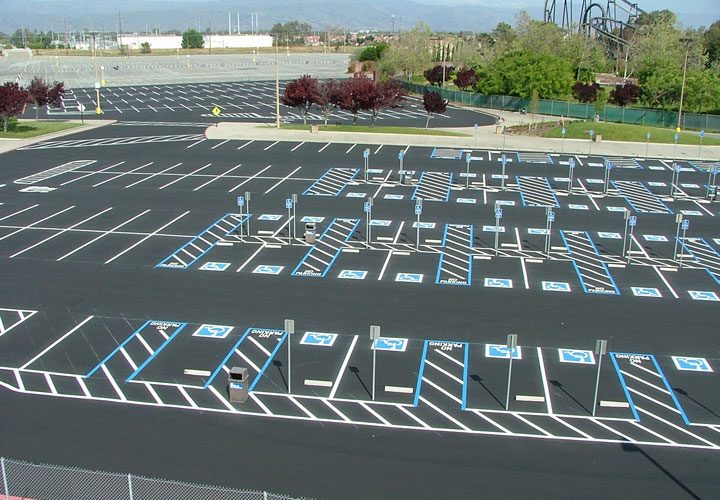
Clear, well-maintained pavement markings are an often-overlooked component of parking lot maintenance that directly affects safety, traffic flow, and regulatory compliance. Faded parking stall lines create confusion and inefficiency. Unclear ADA markings can result in compliance violations and legal exposure.
DRYCO provides professional line striping services including parking stall layout, ADA-compliant stall markings and symbols, directional arrows, fire lane markings, and curb painting. Re-striping is typically completed following each sealcoating cycle and should be evaluated every two to three years based on traffic volume and pavement condition.
Drainage Inspection and Correction
Standing water is among the most destructive forces acting on a commercial parking lot. When drainage is inadequate, water pools on the surface and infiltrates through cracks, softening the sub-base and accelerating structural failure. Effective drainage management is a critical and often underestimated component of long-term parking lot maintenance.
DRYCO evaluates drainage performance as part of every professional assessment, checking that surfaces maintain adequate slope – at least 1.5 percent – to direct water away from the pavement. Keeping drains, catch basins, and curb lines clear of debris is an essential routine maintenance task, and regrading or installing additional drainage infrastructure may be recommended where persistent ponding is identified.
Annual Maintenance Calendar for Commercial Parking Lots
| Season | Recommended Actions |
| Spring | Full inspection, crack sealing, pothole patching, drainage check |
| Summer (before peak heat) | Surface cleaning, oil stain treatment, preparation for sealcoating |
| Fall | Sealcoating, line striping, ADA marking review |
| Winter | Maintenance planning, drainage monitoring, repair scheduling |
Warning Signs Your Parking Lot Needs Professional Attention
Alligator Cracking
Interconnected cracking that resembles a pattern of scales indicates structural failure in the base layer. This cannot be corrected with surface crack sealing and requires full-depth patching, milling, or overlay to address properly.
Potholes or Depressions
Open failures and low spots create vehicle damage risk, trip-and-fall hazards, and liability exposure. Potholes should be repaired as soon as they are identified to prevent rapid expansion into surrounding pavement.
Standing Water
Persistent ponding after rainfall signals a drainage problem that will accelerate pavement deterioration if left uncorrected. Drainage issues compound over time and become significantly more expensive to address once base layer damage has occurred.
Faded or Missing Striping
Markings that are no longer clearly visible affect traffic flow and safety, and inadequate ADA markings can create compliance and liability issues for commercial property owners.
Surface Raveling or Chalking
Loose surface aggregate and a faded, grey appearance indicate that the asphalt binder has oxidized and the surface has lost its protective qualities – a clear signal that sealcoating is overdue.
Why Choose DRYCO for Parking Lot Maintenance
DRYCO is a trusted commercial pavement contractor serving the Bay Area and Central Valley, with over 40 years of experience delivering professional parking lot maintenance services to property managers, facility directors, HOAs, and commercial property owners. Our full suite of services includes sealcoating, crack sealing, pothole repair, overlays, line striping, drainage correction, and comprehensive pavement maintenance programs tailored to the needs and budget of each property.
With over 270 employees and 50 crews across five divisions, we have the capacity to handle projects of any size – from single-lot maintenance visits to multi-site programs spanning the region. Our estimators serve as your dedicated project managers, providing a single point of contact and consistent communication from assessment through completion.
Protect Your Parking Lot Investment with DRYCO
A well-maintained parking lot is not just a surface for vehicles – it is a reflection of your property, a factor in your tenants’ and customers’ experience, and a significant long-term investment that deserves professional attention. With DRYCO’s proven parking lot maintenance strategies and dedicated team, Bay Area and Central Valley property owners can extend pavement life, reduce lifecycle costs, and maintain a safe, attractive, and compliant property for decades to come.
Contact DRYCO today for a free estimate and let us develop a customised parking lot maintenance plan tailored to your property and budget. Call (800) 378-2177 or request your free estimate online now.
Frequently Asked Questions: Parking Lot Maintenance
How often should a commercial parking lot be maintained?
Most commercial parking lots benefit from a professional inspection annually, crack sealing every two to three years, sealcoating every three to five years, and re-striping every two to three years or following each sealcoat cycle. High-traffic properties may require more frequent attention. DRYCO develops customised maintenance schedules based on your property’s specific condition, usage, and budget.
What is the difference between parking lot repair and parking lot maintenance?
Maintenance is preventative – sealcoating, crack sealing, cleaning, and striping performed on a regular schedule to slow deterioration and extend pavement life. Repair is reactive – patching potholes, milling damaged sections, and resurfacing areas where deterioration has already occurred. A consistent maintenance program dramatically reduces the frequency and cost of repairs over the life of your pavement.
How do I know if my parking lot needs an overlay or full replacement?
An overlay is appropriate when the pavement surface has deteriorated but the sub-base remains structurally sound. Full replacement is required when base layer failure is extensive. DRYCO performs professional pavement assessments to evaluate structural condition and recommend the most cost-effective approach for your property.
How long does a commercial parking lot last with proper maintenance?
With consistent sealcoating, crack sealing, and timely repairs, a well-installed asphalt parking lot can last 25 to 30 years or more. Without maintenance, that lifespan can drop to 10 to 15 years, significantly increasing lifecycle costs for property owners.
Does DRYCO offer ongoing parking lot maintenance programs?
Yes. DRYCO works with property managers and facility directors to develop tailored pavement maintenance programs that cover inspections, sealcoating, crack repair, striping, and more on a scheduled basis. A maintenance program gives you predictable costs, consistent quality, and peace of mind that your parking lot investment is being protected year after year.